


In this article
- Is moringa nutrient-dense?
- What did Forest Super Foods’ batch test report?
- What does that mean per capsule or daily amount?
- Which vitamins, minerals and plant compounds occur in moringa?
- Does moringa contain all nine essential amino acids?
- How does processing affect nutrition?
- Why do moringa nutrition figures vary?
Is moringa nutrient-dense?
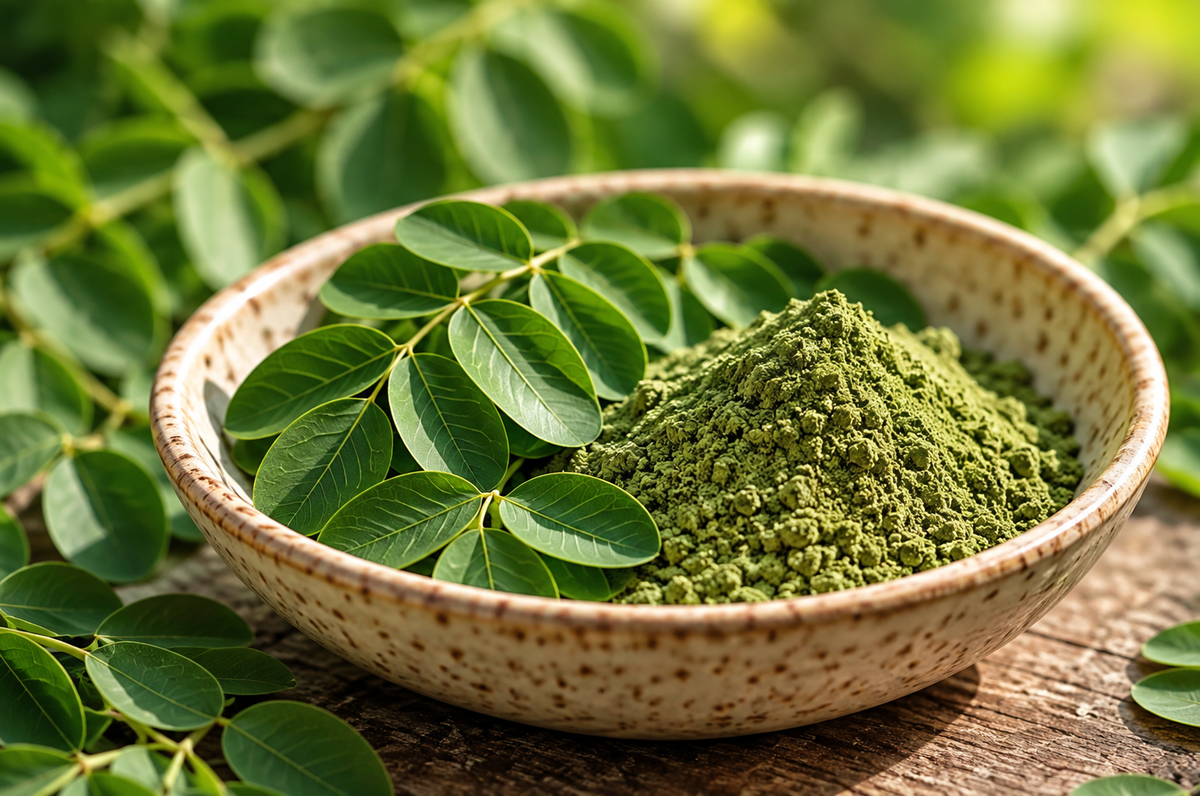
Moringa leaf has an unusually broad nutritional profile. Across Moringa oleifera, more than 90 nutritional chemical components have been described, spanning proteins, lipids, carbohydrates, dietary fibre, vitamins, minerals, amino acids and a wide range of naturally occurring plant compounds. At least 19 different amino acids, including essential and non-essential amino acids, have also been identified. Exact levels vary according to growing conditions, harvest, drying, processing and storage.
Dried leaf powder is more concentrated than fresh leaf because much of the water has been removed. That makes per-100 g values useful for understanding the plant, but the amount delivered by a capsule is much smaller.
What did Forest Super Foods’ batch test report?
Forest Super Foods has product-specific batch testing for its moringa powder. The supplied 2025 analysis reported, per 100 g of tested powder, 22.3 g protein, 7.9 g fat, 51.6 g carbohydrate, 12.1 g total sugars, 12.8 g ash and 1,550 kJ of energy.
Those figures belong to the tested batch and are useful for understanding the raw material. They should not be read as the amount supplied by one capsule.
What does that mean per capsule or daily amount?
Each Forest Super Foods Moringa capsule contains 500 mg of leaf powder. Using the 2025 batch analysis as a simple proportional example, one 500 mg capsule would contain only a small fraction of the per-100 g values.
That is why it is better to describe moringa as a whole-leaf botanical with naturally occurring nutrients rather than treat a capsule as a multivitamin or protein supplement.
Which vitamins, minerals and plant compounds occur in moringa?
- Macronutrients: protein, carbohydrate, dietary fibre and naturally occurring fats, including omega-3 and omega-6 fatty acids.
- Vitamins and related nutrients: provitamin A carotenoids, vitamin B1 (thiamine), vitamin B2 (riboflavin), vitamin B3 (niacin), vitamin B6, folate (vitamin B9), vitamin C and vitamin E (tocopherols).
- Minerals: calcium, magnesium, phosphorus, potassium, iron, zinc, copper, manganese, sodium, sulphur and boron.
- Amino acids and phytonutrients: essential and non-essential amino acids, carotenoids, phenolic acids, flavonoids, glucosinolates, sterols, terpenes, tannins, saponins, glycosides and polysaccharides have all been described in Moringa oleifera.
Moringa's nutritional interest comes from this broad whole-plant matrix rather than any single nutrient. The “more than 90” figure describes nutritional chemical components identified across Moringa oleifera and should not be interpreted as 90 nutrients present at meaningful amounts in every capsule. Nutrient concentrations vary naturally, which is why product-specific amounts are best confirmed through current batch testing.
PubMed sources: Peñalver R, et al. Foods. 2022;11(8):1107. PMID 35454694; Pareek A, et al. Int J Mol Sci. 2023;24(3):2098. PMCID PMC9916933; “Exploring the Phytochemical, Pharmacological and Nutritional Properties of Moringa oleifera: A Comprehensive Review”. Nutrients. 2024;16(19):3423. PMCID PMC11479159. Peñalver et al., Foods (2022), PMID 35454694; Sokhela et al., Nutrients (2023), PMID 37111230.
Does moringa contain all nine essential amino acids?
Moringa leaf protein contains a broad amino acid profile, including essential amino acids. This is nutritionally interesting, but serving size still matters.
A capsule contains 500 mg of whole leaf, so Forest Super Foods Moringa should not be positioned as a replacement for dietary protein.
How does processing affect nutrition?
Fresh leaves contain a high proportion of water. Drying creates a more stable plant material, but the method used can influence heat- and oxygen-sensitive compounds.
Forest Super Foods uses freeze-drying, a low-temperature process that removes water from frozen plant material before the leaf is finely milled and encapsulated.
Why do moringa nutrition figures vary?
Moringa is an agricultural plant, so its composition is not identical everywhere. Soil, climate, variety, leaf maturity, harvest timing, drying method, storage and laboratory method can all influence the numbers reported.
For exact information about the Forest Super Foods product, current batch testing is more relevant than a generic value found online.
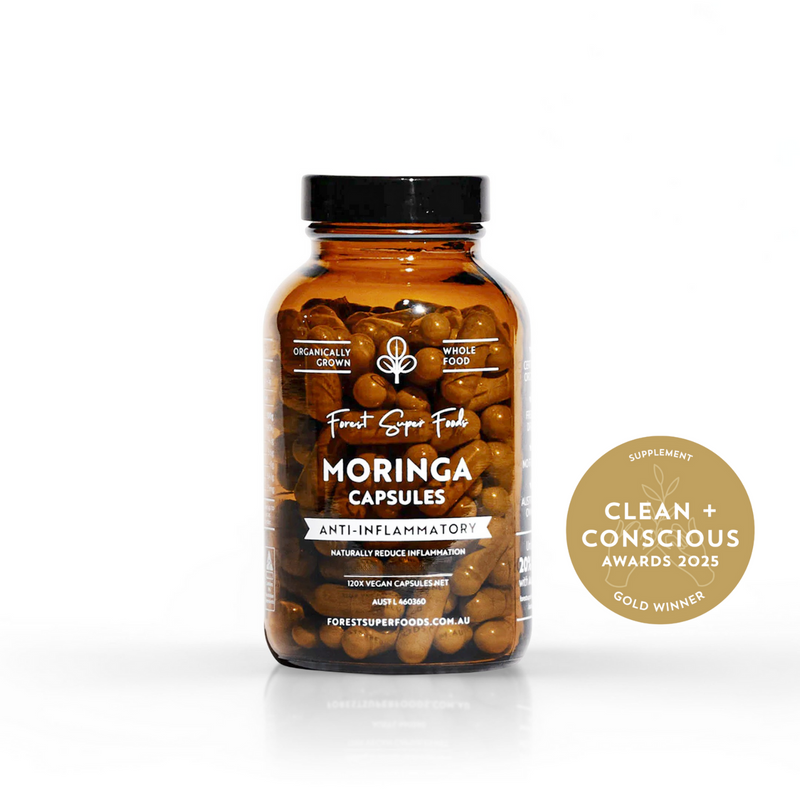
Forest Super Foods Moringa Capsules
Each capsule contains 500 mg of whole Moringa oleifera leaf powder. Product-specific nutrient amounts should be based on current batch testing rather than generic moringa tables.
Organic Moringa CapsulesA powerful supplement for your health and wellness. Order Now |

|
Frequently asked questions
What nutrients are naturally found in moringa leaf?
Published compositional sources identify protein, fibre, fats, B vitamins, folate, vitamins C and E, carotenoids, calcium, magnesium, phosphorus, potassium, iron, zinc, copper, manganese, sodium, sulphur, boron and a range of plant compounds.
Is moringa a protein supplement?
No. Moringa leaf contains protein, but a 500 mg capsule provides only a small amount of total protein.
Why do nutrient numbers differ between moringa products?
Moringa is a plant material. Growing conditions, harvest, drying, storage and testing methods all affect measured composition.

Leave a comment
All comments are moderated before being published.
This site is protected by hCaptcha and the hCaptcha Privacy Policy and Terms of Service apply.